
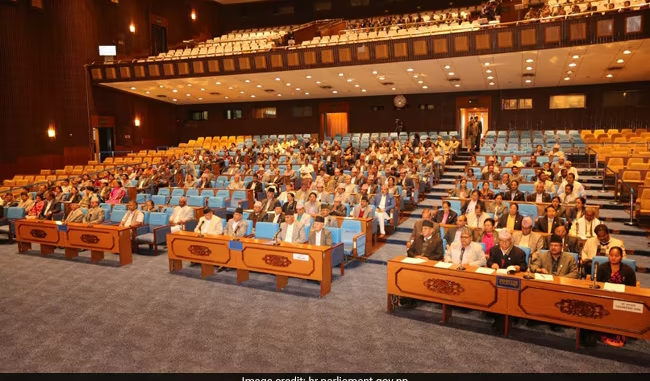
In accordance with the mandamus of the Supreme Court of Nepal, the Unification General Convention of the Non-Resident Nepali Association (NRNA) was successfully held from May 3 to 5, 2025, at the Hyatt Hotel in Kathmandu. Under the leadership of Mahesh Shrestha, the unified NRNA was formed. The Supreme Court’s Implementation Directorate recorded that all procedures had been duly completed in line with the Court’s order and certified that the General Convention was legally accomplished. Since the NRNA is registered with the Ministry of Foreign Affairs of Nepal, the Ministry has already issued a circular to all embassies and consulates instructing them to coordinate henceforth with the NRNA led by Mahesh Shrestha.
While many embassies have already implemented this directive, a few have not. The main reason for this is the interference of Nepal’s political parties within the NRNA. Unfortunately, many Nepali organizations abroad have fallen prey to politicization. One such organization that has suffered this fate is the NRNA itself. Why has the NRNA become so vulnerable to partisan capture? Are there any ways to free it from the clutches of party politics? If there are alternatives, what might they be? This article will revolve around these questions.
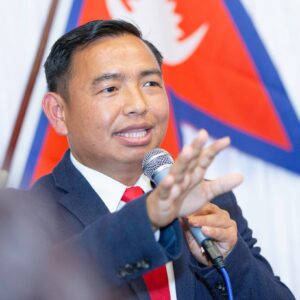
The number of Nepalis who have migrated abroad for employment, education, and opportunity is estimated to be around eight million. The records of 2024 substantiate this figure. In the past year alone, 1.683 million Nepalis went abroad for various purposes. The major destinations for employment include the UAE, Saudi Arabia, Qatar, and Malaysia, while for study, Japan, Australia, the United States, Canada, and the UK are leading choices. In just 2023 and 2024, the number of Nepalis going to the UK for study reached 23,600. Similarly, the number of people leaving permanently by selling or abandoning their land and property in Nepal was about 67,000 last year. If we trace the beginning of this trend of large-scale outmigration back to 2050/51 BS, it has already been 32 years—longer than one generation. For this reason, many children now grow up permanently abroad. This explains why last year alone 132,000 parents moved overseas along with their children. Some of these students eventually return, but many migrate permanently in search of opportunities, and thus should also be counted. These statistics bring the estimate of eight million overseas Nepalis closer to reality.
In Nepal, federal parliamentary elections are held every five years to select legislators who frame laws, rules, and policies. Out of a total of 275 members, 165 are directly elected and 110 are chosen through proportional representation. On average, each directly elected Member of Parliament represents about 109,000 voters. But where is the representation in Nepal’s Parliament for the eight million Nepalis living abroad, whose laws and policies are being made without their voices? How can someone who has never been abroad and never experienced the hardships of migration truly legislate for migrant Nepalis? How many innocent Nepalis are languishing in foreign jails right now? If Nepalis are imprisoned abroad, why can’t they be brought home to serve their sentences in their own country? Does the responsibility of the Nepali government end the moment its citizens cross the national border? Shouldn’t the state remain accountable to its people, wherever they are? Why does a government whose economy depends on 30% remittances treat its own citizens with such negligence?
If the government of Nepal truly wants to be responsible and accountable to migrant Nepali workers, why not learn from progressive countries that have, for over two and a half decades, adapted to modern realities and created representative mechanisms?
Countries such as Italy, France, Tunisia, Algeria, Cape Verde, Portugal, Mozambique, Colombia, and Romania offer important lessons. These ten nations have established systems through which their citizens abroad are directly represented in their national parliaments.
Democracy means following the choice of the majority—more than 51%—and securing agreement from the minority to respect that choice until the next election. The electoral system, which converts every citizen’s vote into seats in parliament, is the most important mechanism of democracy. When studying electoral systems, the French model stands out as the most advanced. In France, both the President and the Prime Minister are directly elected. If no candidate secures more than 50% in the first round of voting, the top two contenders go on to a second round. The French model has many dimensions, one of which is that about 2.5 million French citizens abroad elect 11 Members of Parliament directly from overseas constituencies to sit in the National Assembly. Within France and its overseas territories, 566 MPs are elected, and with the 11 from abroad, the total becomes 577.
In France’s upper house, the Senate, 12 senators are indirectly chosen to represent the diaspora. The Senate has a total of 349 members. This may sound unusual to us, so who were the architects of such arrangements? The concept of direct elections in France was brought forward by Charles de Gaulle, the founder of the Fifth Republic, military general, and former president. The system of diaspora representation was introduced by former President Nicolas Sarkozy, who served from 2007 to 2012. It was Sarkozy who, in 2010, formally established overseas representation.
In France’s National Assembly, overseas citizens are divided into 11 constituencies: (1) America and Canada, (2) Latin America and the Caribbean, (3) Northern Europe, (4) Benelux countries, (5) Italy, Vatican, and San Marino, (6) Switzerland, (7) Germany and Central Europe, (8) Egypt, Israel, Turkey, Greece, (9) North Africa and West Africa, (10) Central and East Africa, and (11) Asia, Oceania, and Eastern Europe. This distribution reflects France’s colonial history in Africa, which accounts for greater representation from that continent. Even if they take other citizenships, French nationals are not required to renounce their own. The moment they leave their homeland, they can register at a consulate or embassy and vote either directly, by mail, or online.
Thus, 2.5 million diaspora French are directly represented by 11 MPs, meaning one MP for about 227,000 citizens.
The first country to introduce such direct representation was Italy, which amended its constitution in 2001 to grant rights to its overseas citizens. Italy divided the world into four constituencies: Europe, South America, North and Central America, and Africa-Asia-Oceania. From these regions, 8 MPs are directly elected to the lower house and 4 to the upper house. Regions with larger Italian populations elect more MPs—for instance, 3 from Europe, 2 each from South and North America, and 1 from the remaining regions.
The concept was developed in the late 1990s. The key figure behind securing overseas representation for Italians was Mirko Tremaglia, whose name lives on in the “Tremaglia Law” of 2001. Tremaglia also served as Minister for Italians Worldwide from 2001 to 2006.
Other countries also follow this progressive practice of directly electing overseas MPs: Tunisia (6), Algeria (4), Cape Verde (3), Portugal (2), Mozambique (2), Colombia (1), Croatia (1), and Romania (1).
While such progressive developments continue abroad, the government of Nepal remains narrow-minded, harsh, and indifferent toward its own diaspora.
It is a painful irony that while Nepal opens its doors to foreigners, it indirectly excludes its own descendants through restrictive citizenship laws and the flawed implementation of the Non-Resident Nepali citizenship provision. Even the fundamental right to vote and to elect representatives to parliament has been quietly denied. Some forward-looking countries—Israel, Haiti, Serbia, Mali, Syria, Yemen, among others—have even established separate ministries dedicated to their diaspora, with full ministerial responsibility for their rights, welfare, and protection. Yet the government of Nepal, instead of protecting its citizens, seems intent on rendering them foreigners.
In a landlocked country, there is often fear of population inflows from neighbors. But since the definition of NRNA excludes South Asian countries, granting NRN citizenship with political rights would not invite mass migration from neighboring India or elsewhere. For those Nepalis who have crossed seven seas, granting citizenship with political rights poses no such threat. Citizenship without political rights is meaningless—it is a deception against one’s own citizens. At a time when the state is deliberately making its own people into foreigners, when descendants’ rights and the continuity of citizenship are denied, when even the natural right to vote is withheld, the situation is deeply distressing.
Like the ten countries mentioned above, Nepal too should arrange for at least five MPs to be chosen from among the eight million overseas Nepalis through the NRNA, or some other structure, to represent them in parliament. This would completely remove the political parties’ interference in the NRNA. According to the 2021 census, Nepal’s population is 29.2 million, and with 275 MPs, each represents about 106,000 people. If 8 million citizens abroad were to be represented proportionately, around 75 MPs should be directly elected from the diaspora. France, with a population of 66.8 million and 577 MPs, has each MP representing about 116,000 citizens. Looking at France’s ratio, where 2.5 million overseas citizens elect 11 MPs, Nepal would need to allocate about 35 seats to overseas representatives.
The Supreme Court of Nepal, on March 21, 2018 (Chaitra 7, 2074 BS), issued a directive order to the government to make arrangements for Nepali citizens abroad to vote in national elections. The Court instructed the government, the Election Commission, and Parliament to ensure the legal right of migrant citizens to vote. Casting ballots for home constituencies from abroad may be administratively challenging. Therefore, the more feasible arrangement would be for overseas Nepalis to vote directly for candidates contesting from abroad, and elect their own MPs to represent them. In many ways, the leadership of the NRNA has already been carrying out a quasi-legislative function informally. Another simple option would be for the Ministry of Foreign Affairs, through the NRNA, to nominate at least five MPs to parliament. If direct elections among the diaspora are not possible, proportional allocation through Nepal’s mixed electoral system could be adopted, with the NRNA’s legal network handling the process.
In conclusion, since all matters must currently be brought to Parliament through party-elected MPs, the diaspora is compelled to lobby political parties just to raise its issues. Because of this lobbying, the NRNA has become trapped in partisan politics. As a result, not only the NRNA but the entire diaspora community is deprived of fundamental rights. To permanently resolve the problem of politicization, it is imperative to establish a system, in line with the demands of the new era, whereby overseas citizens are directly represented in Parliament—either through the French or Italian model, or via the NRNA. If representation is arranged through the NRNA, then diaspora Nepalis would also receive their long-denied voting rights, as mandated by the Supreme Court. If granted, NRN MPs could be elected at the time of the NRNA Global Conference, alongside the selection of its office bearers. Since the establishment of the NRNA in 2003, and up to 2025, no one has studied or advocated from this angle. Now, however, every NRNA leader and activist must raise a strong voice, and launch a vigorous campaign, to ensure that among the eight million overseas Nepalis, directly elected NRN MPs are finally sent to represent them in Nepal’s Parliament.
(The author holds a Master’s degree in International Relations from Canterbury University, UK, and is a researcher in electoral systems. He is also the Vice President of the NRNA International Coordination Council.)